|
|
|
Sessions > Session 7
26 March 2026
15:45 - 17:15 - Auditorium de la Grande Galerie de l'Évolution
Inter- and transdisciplinary approaches for the sustainable management of marine invertebrates
Session chair: Anaïs Marrast, French National Research Agency (ANR), France
Women and shellfish: a companion modelling approach for the management of an overexploited common in West Africa
Mia Reynaud1,2,4, Christophe Le Page2,3, Clara Therville2, Yoann Thomas4
1AgroParisTech, France
2SENS, IRD, CIRAD, Université Paul Valery, Montpellier 3, 71 avenue du professeur Henri Serre, Montpellier, France
3CIRAD, UMR SENS, F-34398 Montpellier, France
4IRD, CNRS, Université de Bretagne Occidentale, Ifremer, UMR LEMAR, F-29280 Plouzané, France
Keywords: socio-ecological system; commons; companion modelling; agent-based model; serious game
Women’s shellfisheries in West Africa are essential yet understudied social-ecological systems. In the Sine-Saloum Delta (Senegal), the bloody cockle (Senilia senilis) fishery plays a key role in supporting coastal livelihoods, but is increasingly threatened by environmental and socials changes that challenge the capacity of local governance to respond effectively. Within the WOSHECO project, our research contributes to an inter- and transdisciplinary effort to better understand these coupled dynamics and to support adaptive co-management of small-scale shellfisheries.
Anchored in commons theory, we investigate how social, ecological, and institutional factors interact to shape the fishery’s adaptive capacity. Drawing on a Companion Modelling approach that blends disciplinary perspectives situated knowledge and participatory tools, we bridge multiple scales of inquiry and foster the co-production of actionable knowledge for sustainable management.
Here, we highlight how through several years of fieldwork combining qualitative and quantitative methods, we document ecological dynamics, local knowledge, evolving fishery practices, and existing governance arrangements. Our preliminary insights highlight how compounding stressors are challenging resource sustainability. These empirical results inform the development of an agent-based model co-designed with fisherwomen and other stakeholders. The model, which is available in the form of a serious game and digital modelling tool, serves as a boundary object to explore management and governance scenarios, facilitate dialogue across disciplines and knowledge systems, and support the coproduction of solutions for the sustainable management of marine invertebrate resources and address the wicked problem of declining shellfisheries under global change.
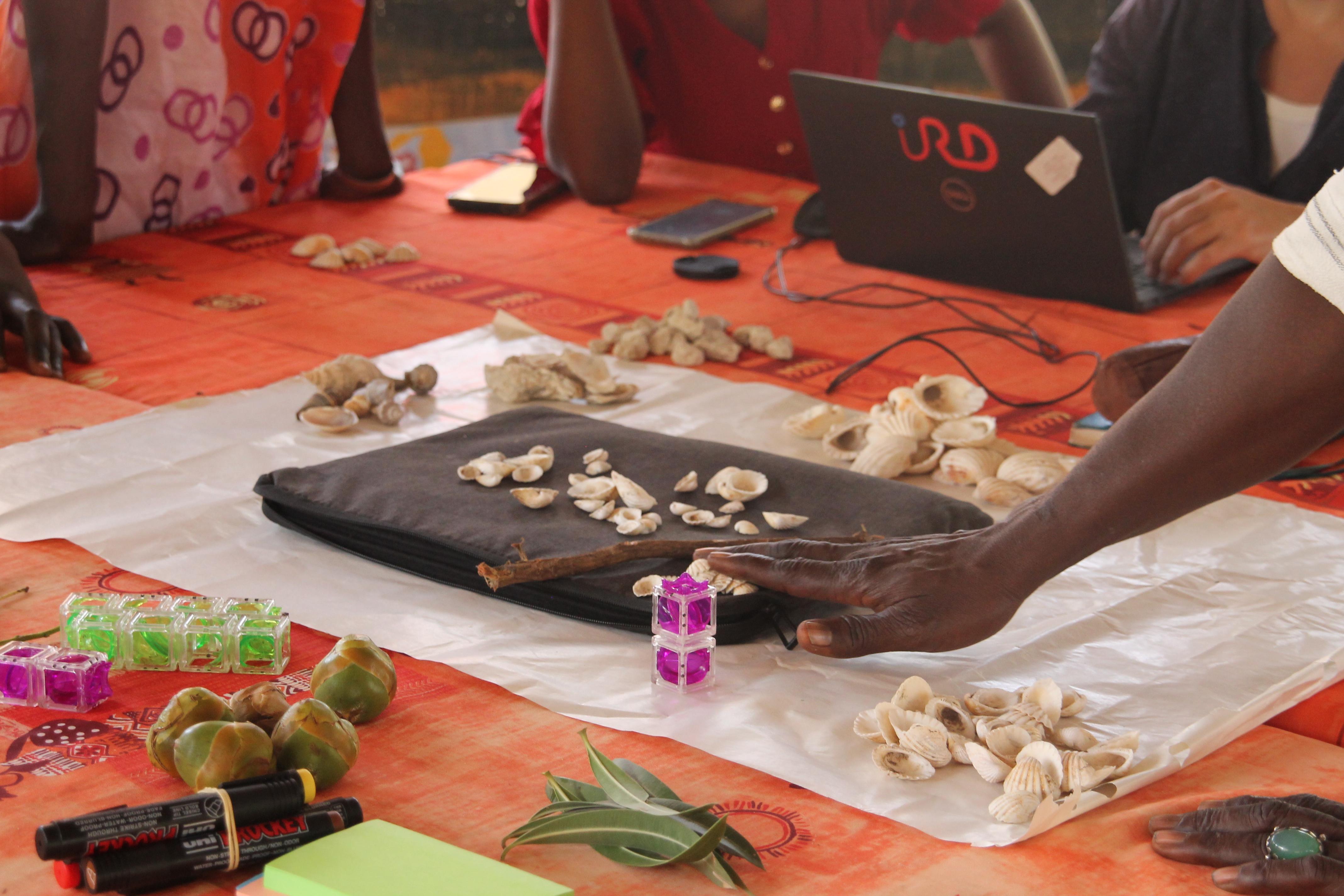
Picture: A mini-game used during a group workshop in Falia (Senegal) to elicit local knowledge and stimulate discussion within a companion modelling process.
© Mia Reynaud
The urgent need of inclusive management of invertebrate collection activities in Zanzibar’s seascapes
Maricela de la Torre-Castro1, L. Lindström2, NS Jiddawi3
1Stockholm University, Department of Physical Geography, Sweden
2Stockholm University, Department of Political Science, Sweden
3University of Dar es Salaam, Institute of Marine Sciences, Zanzibar, Tanzania (emeritus)
Keywords: inclusive management, gender and marine resources, invertebrate collection, Zanzibar, Western Indian Ocean
Zanzibar has a historical tradition of invertebrate collection in intertidal and subtidal areas surrounding the island, with people from all ages performing the activity (women, men, elders and children). However, there are strong gender differences in access to collection grounds, valuable species and fishing methods. In this presentation, the characteristics of the social-ecological system dealing with invertebrates in Zanzibar intertidal areas will be presented. The focus will be on gender differences (men tend to collect the most valuable species, e.g., sea cucumbers), the susceptibility of invertebrates to overexploitation (declines in abundance have been recorded in relatively short periods of time, as an effect of intensive collection and due to seaweed farms placed over productive ecosystems); economic potential values (invertebrates’ high economic value in protected areas) and the development of inclusive management (management that consciously and explicitly addresses gender). The Zanzibar case represents an example of a tropical environment in which tradition and modernity collides facing strong exogenous drivers such as globalization and tourism expansion and endogenous such as population growth and lack of alternative livelihoods. The research argues for integrated, social-ecological approaches (including spatial management, community participation, improving monitoring and linking habitat protection to invertebrate conservation) rather than single-tool top-down regulation.
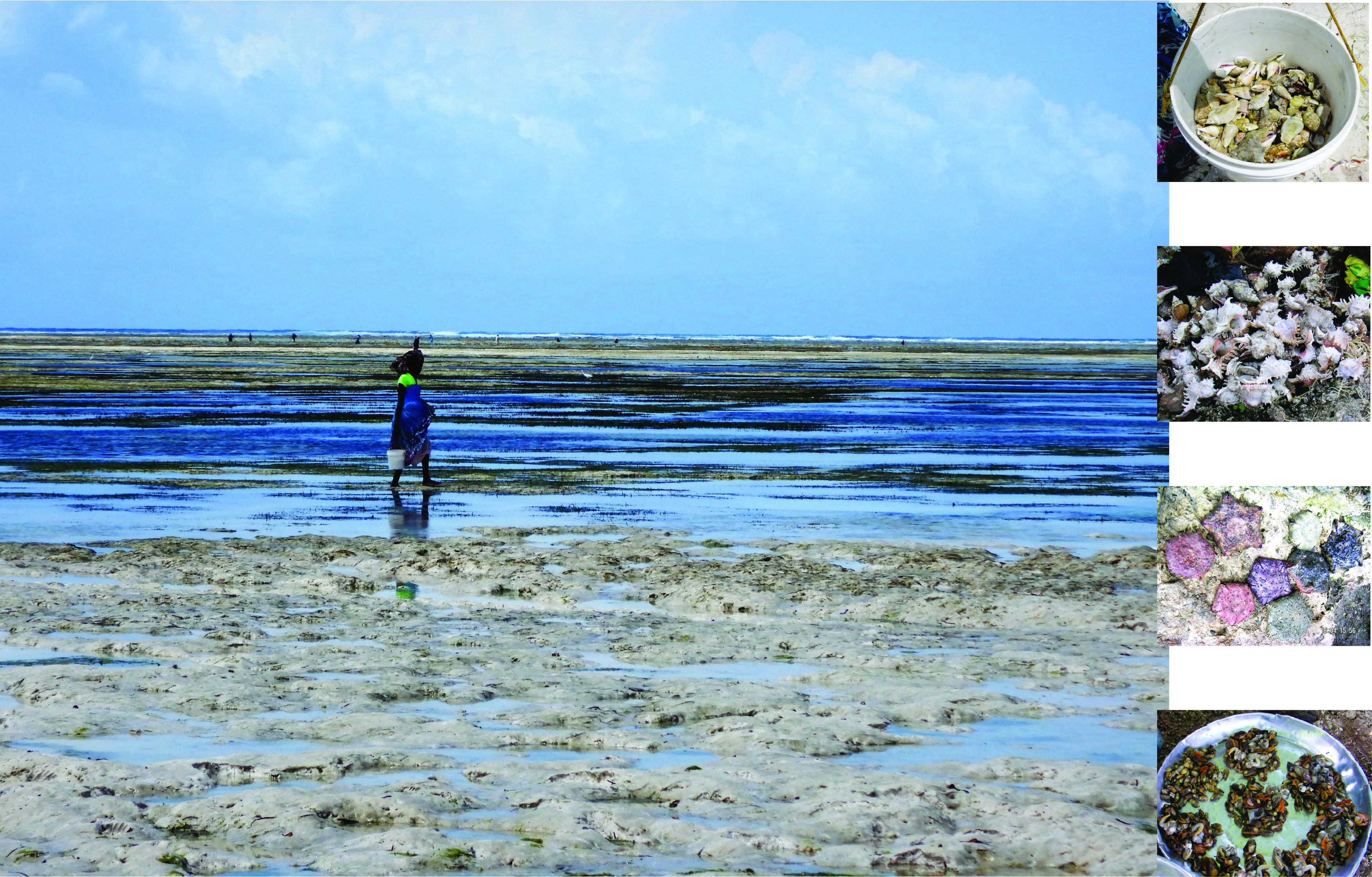
Picture: Invertebrate collection in the East coast of Zanzibar. In this case, a woman is coming back from the collection activity with a bucket containing the catch over a complex seascape composed by muds, seagrasses and hard coral substrate. To the right, examples of the invertebrates normally collected and used in the area. The invertebrates have multiple uses, selling to tourists, home consumption or bait for small-scale fisheries.
© Maricela de la Torre-Castro
Sentience in marine invertebrates:vidence & ethics
Andrew Crump1
1Royal Veterinary College, Hawkshead Lane, North Mymms, Hatfield, Hertfordshire, AL9 7TA, United Kingdom
Keywords: cephalopod, decapod, sentience, pain, legislation
When considering human interactions with marine invertebrates, a common theme is the implications for animal welfare. Are fisheries and aquaculture causing these animals pain and suffering? To address this question, we first need to establish whether and which marine invertebrates are sentient – capable of experiencing subjective states like pain. My research focuses on evaluating the evidence for sentience in invertebrates, and considering the implications for their welfare. In 2020, my colleagues and I advised the UK government on whether to expand animal welfare law to cover marine invertebrates. We evaluated over 300 cognitive, behavioural, and neurobiological studies to assess the evidence for sentience in cephalopod molluscs and decapod crustaceans. Following our recommendations, the UK government amended the Animal Welfare (Sentience) Act 2022 to legally recognise cephalopods and decapods as sentient. This legislative change highlights how scientific inquiry can help to shape policy, and raises questions about how humans treat these animals.
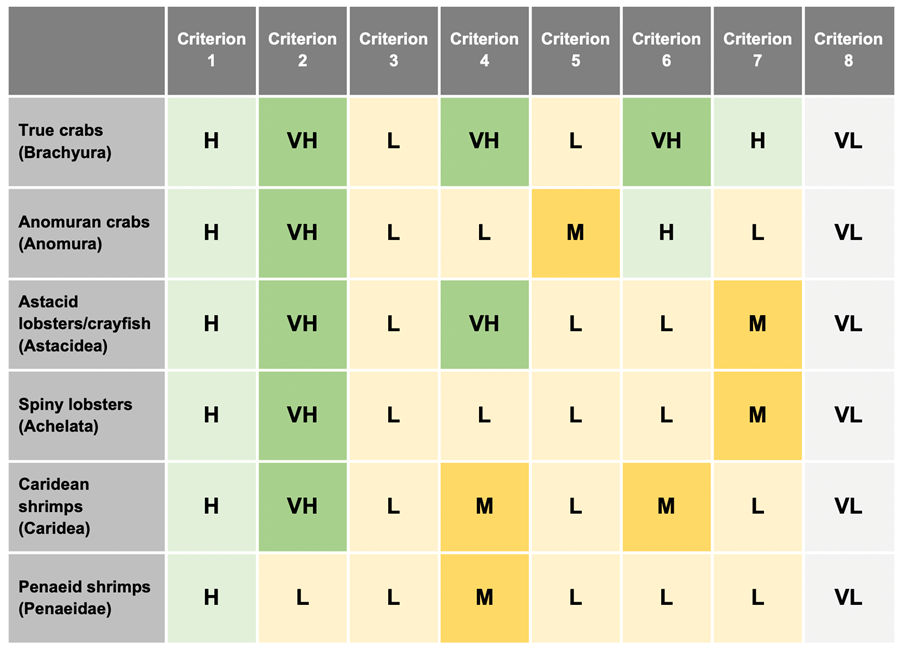
Picture: A summary of the evidence of sentience in decapods. The colours and letters represent our confidence level that the criterion
in question (column) is satisfied by the order (or orders) of animals in question (row). VH (dark green) indicates very high confidence, H
(light green) indicates high confidence, M (dark yellow) indicates medium confidence, and L (light yellow) represents low confidence.
Since we have not found evidence to support criterion 8 in any decapod, we have used the category of very low confidence (VL, light
grey) in this case.
© Birch et al., 2021
Pacific Northwest Indigenous clam tending: cultivating a network of collaboration
Marco B.A. Hatch1, Nicole Smith2, Clam Garden Network3
1Western Washington University, Bellingham WA, USA
2Clam Garden Network and Independent Archaeologist, Canada
3Clam Garden Network
Keywords: Traditional indigenous mariculture, clam garden, equitable exchange
Clam gardens are a traditional Indigenous mariculture technology found along the Northwest coast of North America. For millennia Indigenous peoples have been building rock-walled terraces in the region’s large intertidal zone to create, expand and enhance habitat for clams and other seafoods. The Clam Garden Network is a community of First Nations, academics, researchers, and resource managers from coastal British Columbia, Washington State, and Alaska whose work supports the cultural and ecological importance of clam gardens and traditional clam management. Through the Clam Garden Network we create equitable exchanges between Indigenous communities and researchers to share ancestral clam garden practices and the research that can support clam garden revitalization. Together, members of the Network have demonstrated the continuous use of clam gardens along the coast for 4,000 years into present day, highlighted the greater productivity of clam beaches when compared to unwalled beaches, and demonstrated the resiliency of this flexible technology to environmental changes such as extreme heat and sea level change. While the use of many clam gardens was interrupted by colonization, Indigenous communities today are reclaiming their beaches, restoring or building new clam gardens, and regaining access to traditional foods, language and cultural practices. Central to this research is ensuring that any projects on Indigenous technologies are conducted in partnership and consultation with the Indigenous descendant communities. This ensures trusting relationships are formed with researchers, ultimately leading to more impactful research that fully appreciates the cultural context, history, and socio-ecological relationships of the clam garden system.
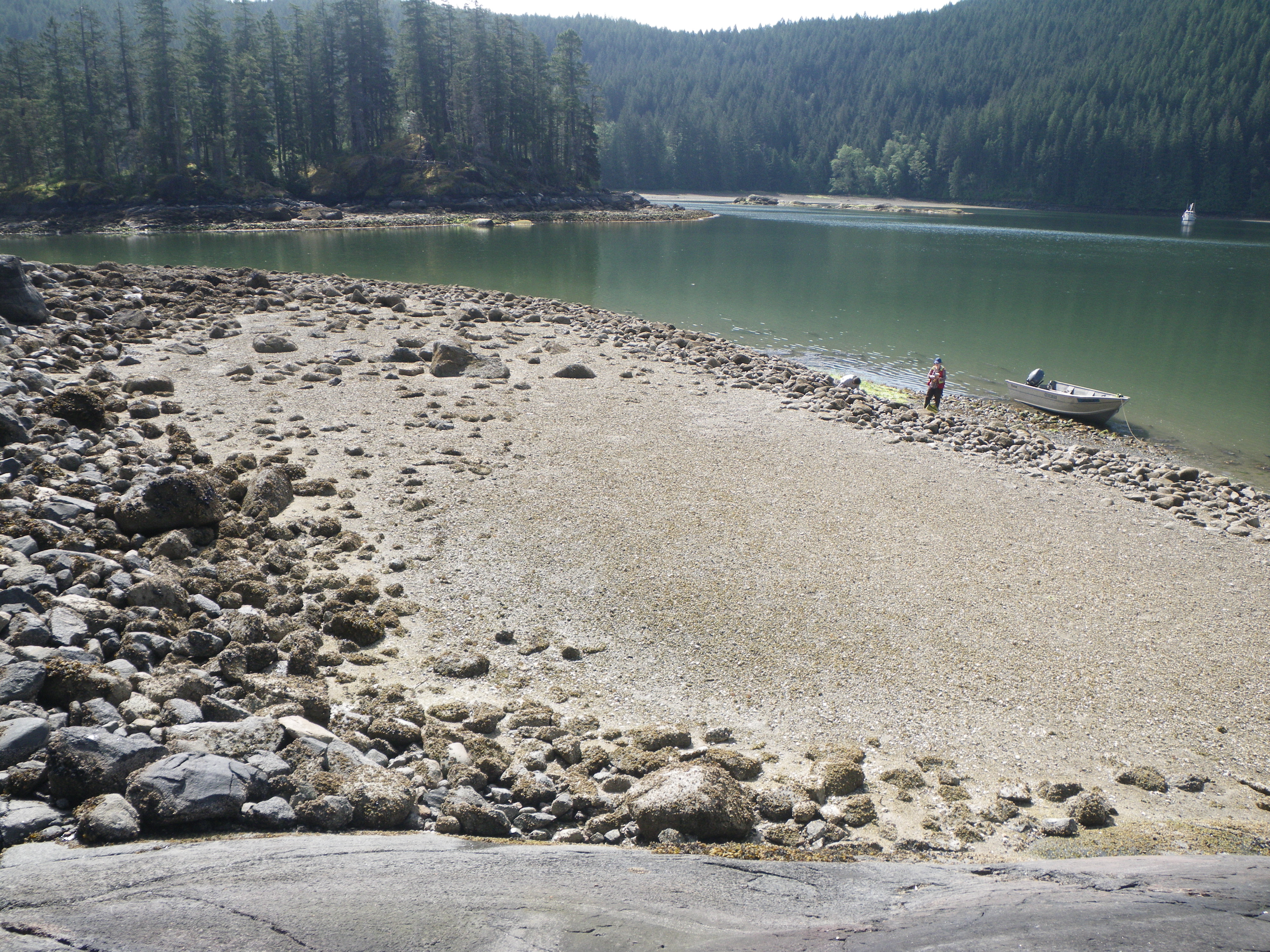
Picture: Survey at a clam garden on Quadra Island, Canada.
© Nicole Smith


