|
|
|
Programme
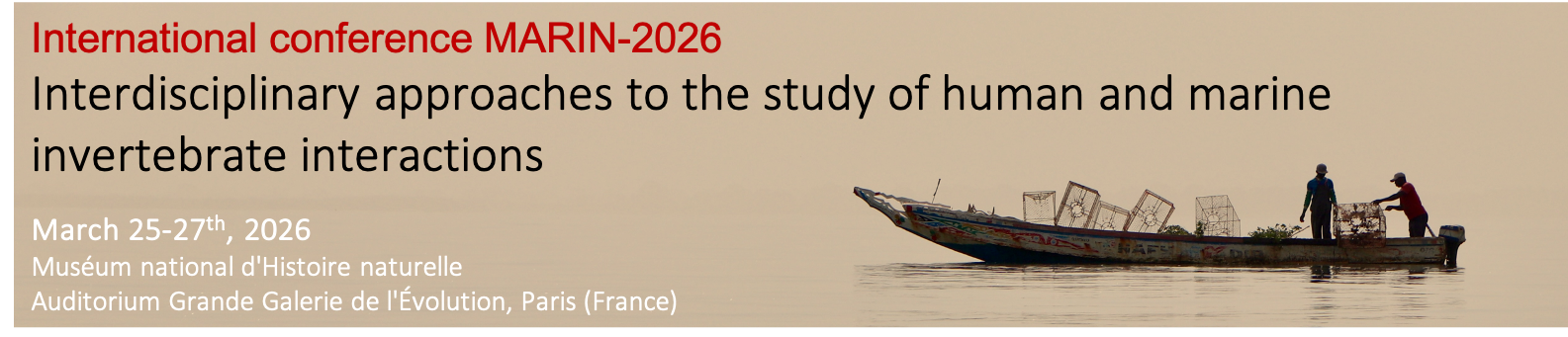
The conference will take place over three days, from 25 to 27 March 2026, at the Muséum national d’Histoire naturelle in Paris. The first two days will be held in the Auditorium of the Grande Galerie de l’Évolution (GGE) at the Jardin des Plantes and will be open to students, academics, scientists, and practitioners. The third day will be reserved for speakers and conference organisers.
The programme is structured into seven sessions, each consisting of four 12-minute oral presentations, for a total of 28 presentations. At the end of each presentation a 5-minute discussion will be held.
Download the conference programme (PDF).
First day - 25 March 2026 - Auditorium of the Grande Galerie de l’Évolution
09:30 – 10:00 Registration
10:00 – 10:20 Welcome remarks
Frédérique Chlous, Gilles Kleitz, Ariadna Burgos
10:20 – 10:45 Keynotes
Philippe Bouchet, Alexander Mawyer
10:45 – 12:00 Session 1: Human and marine invertebrate interactions in ancient environments
Chair: Frank Thomas
- Shells as indicators of human behaviours and environments: A few archaeological reflections - Marcello A. Mannino
- Climate change, migrations, and the peopling of sine-Saloum mangroves (Senegal) by mollusc gatherers in the past 6000 years - Matthieu Carré
- When crabs show us how to preserve the intangible heritage of intertidal zone exploitation - Catherine Dupont & Alessandro Marcuzzi
- Indigenous oyster harvest and cultural connections from past to present - Leslie Reeder-Myers
12:00 – 14:00 Lunch break
14:00 – 15:15 Session 2: Marine invertebrate fisheries
Chair: Yoann Thomas
- Rising stars, moon and tides: the cultural and ecological dynamics of the sea worm Palola viridis fishery in Timor-Leste - Joctan Dos Reis Lopes
- Forgotten fisheries: characterizing small-scale shellfisheries in Solomon Islands - Jan van der Ploeg
- Crossing the tides: an interdisciplinary journey to understand gleaning fisheries - Benedetta Longoni & Ariadna Burgos
- More than a fishery: ark clams (piangua, Anadara spp.) as cultural keystones and gendered economic lifelines in coastal tropics - Ana M. Ortiz
15:15 – 15:45 Coffee break
15:45 – 17:00 Session 3: Aquaculture of marine invertebrates: opportunities and challenges
Chair: Marco Hatch
- Between animal and vegetal, the ambiguous status of oysters on French farms - Julie Dulat
- From reciprocity to commodity: shifting human-invertebrate entanglements and socio-ecological change in the Ecuadorian mangroves - Melva Treviño
- Feasibility of restorative aquaculture of Cittarium pica for reef recovery and food security in the Dutch Caribbean - Luc Roozendaal & Alwin Hylkema
- Producing shrimp in certified farms: does it improve their welfare? - Urja Thakrar
Second day - 26 March 2026 - Auditorium of the Grande Galerie de l’Évolution
09:30 – 10:45 Session 4: Marine invertebrate species and cultural practices: art, rituals, and magic
Chair: Tamatoa Bambridge
- Marine invertebrates in funerary contexts: food, ritual and symbolic practices in the Three Gauls - Caroline Mougne & Nicolas Morand
- Between wonder and extinction: the artistic and scientific construction of marine invertebrate perception - Chloé Pretesacque
- Marine invertebrates and cultural practices: answers from the zoological phonebook - Mark Carnall
- Divinatory and talismanic cowries from Senegal: between fieldwork and museum collections - Alain Epelboin & Manuel Valentin
10:45 – 11:15 Coffee break
11:15 – 12:30 Session 5: Craft, trade and curio trade of marine invertebrates
Chair: Nicole Smith
- Tabletterie in Méru: history, craftsmanship, and heritage of mother-of-pearl - Florentin Gobier
- Shellcraft in Papua New Guinea: the role of local knowledge and marine invertebrates through a livelihood lens - Nittya S.M. Simard
- The enduring value of shells: symbolic currency in Solomon Islands - Janet Saeni-Oeta & Jan van der Ploeg
- Mollusks and money: the role of shells in the development of monetary economies around the world - Mikael Fauvelle
12:30 – 14:00 Lunch break
14:00 – 15:15 Session 6: Food security, nutrition and sanitary risks of marine invertebrates
Chair: Eva Maire
- Nutrients on the move: production, export, and domestic retention of nutrients from farmed molluscs in South Africa - Maria J. Darias
- Predicting the nutrient content of aquatic invertebrates (and other aquatic foods...) - James P.W. Robinson
- Microbiological monitoring of shellfish production areas in France: approaches, socio-economic impacts, and research perspectives - Yann Reynaud
- Cephalopods at the crossroads of fisheries, contamination, and environmental change - Thomas Lacoue-Labarthe
15:15 – 15:45 Coffee break
15:45 – 17:15 Session 7: Inter- and transdisciplinary approaches for the sustainable management of marine invertebrates
Chair: Anaïs Marrast
- Women and Shellfish: a companion modelling approach for the management of an overexploited common in West Africa - Mia Reynaud
- The urgent need of inclusive management of invertebrate collection activities in Zanzibar’s seascapes - Maricela de la Torre-Castro
- Sentience in marine invertebrates: evidence and ethics - Andrew Crump
- Pacific Northwest indigenous clam tending: cultivating a network of collaboration - Marco B.A. Hatch & Nicole Smith
17:15 – 17:30 Closing remarks
17:30 – 19:45 Friendly gathering at l'Orangerie (MNHN) & Exhibition Swaying Fossils by Camille Sauton
Third day - 27 March 2026 - Jardin des Plantes
09:00 – 16:45 Speakers' workshop


