|
|
|
Sessions > Session 1
25 March 2026
10:45 - 12:00 - Auditorium de la Grande Galerie de l'Évolution
Human and marine invertebrate interactions in ancient environments
Session chair: Frank Thomas, University of the South Pacific (USP), Fiji
Shells as indicators of human behaviours and environments: A few archaeological reflections
Marcello A. Mannino1
1 Department of Archaeology & Heritage Studies, Aarhus University, Denmark
Keywords: Molluscs, archaeomalacology, shell middens, food, actualistic studies
Humans have interacted with marine invertebrates for hundreds of thousands of years. This has been both with live individuals, more often than not for dietary needs, and with their exoskeletons, which have been useful for a wide array of utilitarian and symbolic purposes. Most archaeological investigations on marine invertebrates reconstruct how humans used molluscs, albeit rarely unlocking the full archival breadth of their shells. To do so, requires an interdisciplinary approach that combines more traditional zooarchaeological analyses on molluscan assemblages along with any other method that allows us to reconstruct: (i) the environmental conditions endured by the invertebrates in life, (ii) the nature of anthropic interactions with the living animals and (iii) the human behaviours linked to the processing and discard of their shells.
Archaeological studies of marine molluscs (which practitioners call archaeomalacology) should thus include: sclerochronological and isotopic analyses, ethnoarchaeological investigations of recent or present anthropic shell assemblages and targeted geoarchaeological approaches to excavate shell-bearing deposits and contexts. These methods rely on actualistic principles, which should push archaeologists to collaborate not only with marine biologists and ecologists, but also with peoples who subsist traditionally. This should be a ‘research emergency’, given that coastal environments are changing through anthropogenic impacts and traditional human behaviours are disappearing fast. There are mutual benefits to building collaborative bridges between practitioners studying invertebrates in the past and present, given that the former cannot grasp the full breadth of human behaviours and the latter cannot fathom to what extent present-day environments are natural.
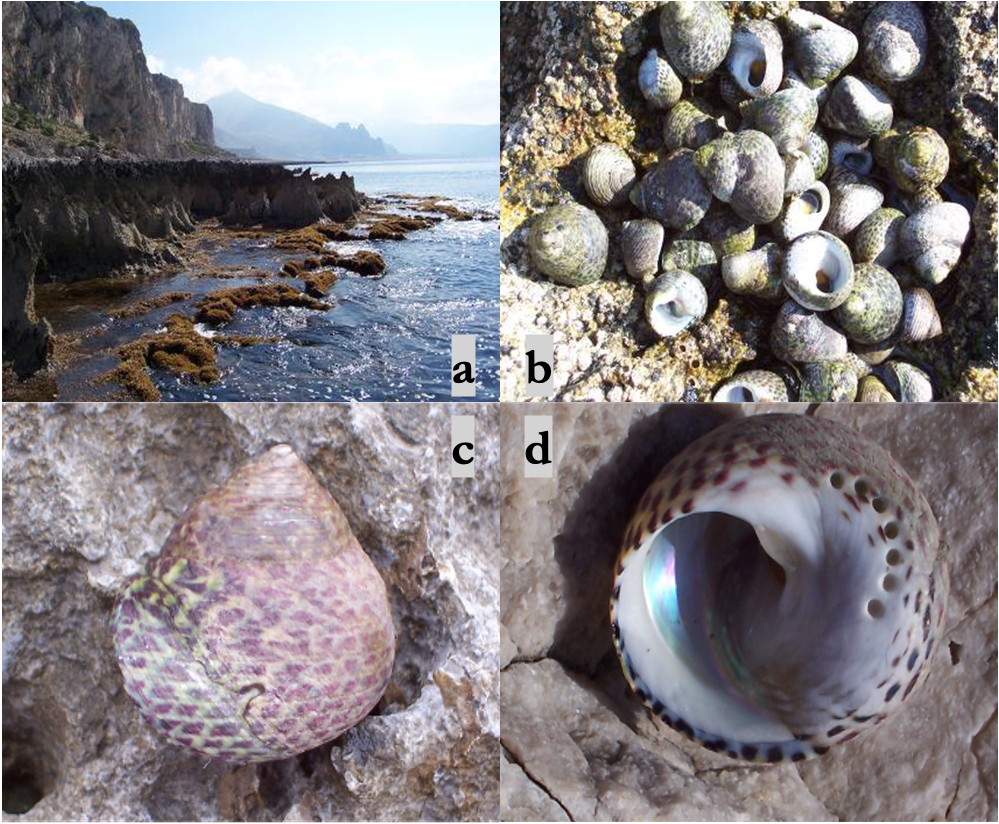
Picture: Mark-release-recapture study of the intertidal gastropod Phorcus turbinatus. (a) rocky shore in NW Sicily (San Vito lo Capo peninsula) at which a study was conducted; (b) hand collection of adult individuals of Phorcus turbinatus; (c) notched individual marked on the aperture at the time of the start of the mark-release-recapture study; (d) code of dots to identify the specific marked individual.
© Marcello A. Mannino
Climate change, migrations, and the peopling of sine-Saloum mangroves (Senegal) by mollusc gatherers in the past 6000 years
Matthieu Carré1, Louis Quichaud2, Abdoulaye Camara3, Julien Thébault4, Yoann Thomas4
1 LOCEAN laboratory, CNRS, IRD, MNHN, Sorbonne Université, 4 Place Jussieu, Paris, France
2 École normale supérieure de Lyon, Département de biologie, Lyon, France
3 Laboratoire d’archéologie, Institut Fondamental d’Afrique Noire, Université Cheikh Anta Diop de Dakar, Dakar, Sénégal
4 Univ Brest, CNRS, IRD, Ifremer, LEMAR, 29280 Plouzané, France
Keywords: Senegal, mangroves, paleoclimate, human migrations, radiocarbon, stable isotopes
We present a reconstruction of human demography and shell fishing activity in the Sine-Saloum mangrove Delta (Senegal) in the Late Holocene using the summed probability density (SPD) of radiocarbon dates in archaeological shell middens. We explore how this local history relates to the climatic and political history of West Africa. We find that traces of human presence were scarce from 6000 to 2000 yr BP, partly because the geomorphology of the estuary was less favourable to human settlements at that time. A specialized shell fishing population migrated massively to the Sine-Saloum around 2000 yr BP, at the end of the aridification trend that followed the African humid period. This population, likely coming from the northern coast in search of land and resources, fleeing the Saharan desertification found refuge in the coastal mangroves and reached a maximum activity at about 1700 yr BP. This period corresponds to the beginning of trans-Saharan trade, and to a political complexification that would give rise to the Ghana empire. During the past 1600 years, we also explore possible link between mollusc gatherers demography and climate variability reconstructed from shell isotopic records. Most sites in the Sine-Saloum islands were abandoned in the 14th century, before the arrival of Europeans, possibly because intensive shell fishing was not sustainable anymore. Shortly after, a new population lead by the Manding Guelwars, moved to the Sine Saloum. Shellfishing was then reduced, possibly because activities were more oriented to the new trade with Europeans or to a prosperous agriculture in more humid climatic conditions that prevailed from 1500 to 1800 CE.
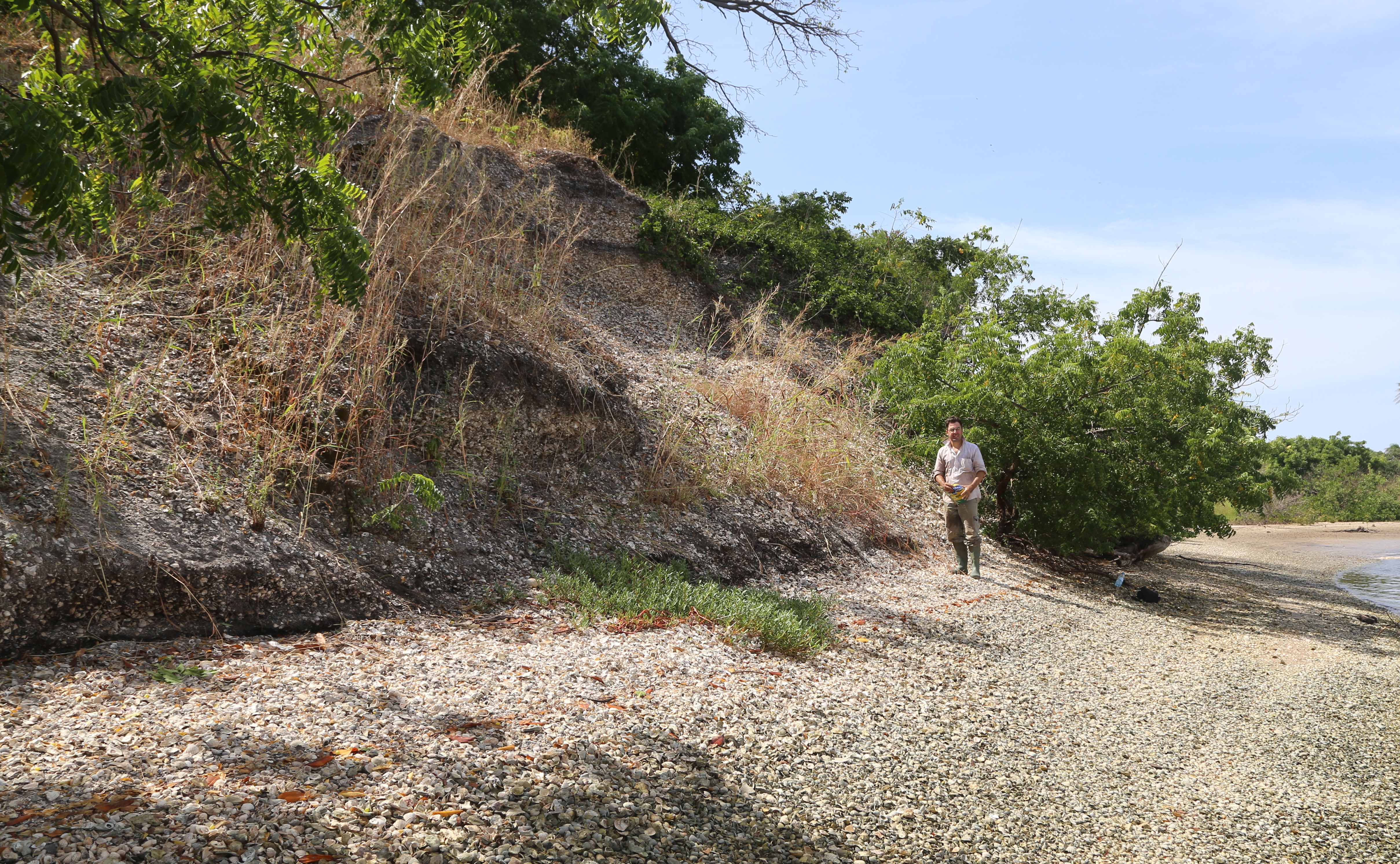
Picture: The monumental archaeological shell middens of the Sine-Saloum (>10 m high) bear witness to large-scale mollusk-gathering activities dating back approximately 1,700–1,300 years. Eroded by tides and waves, their exposed stratigraphy records the history of climate and human activity.
© Matthieu Carré
When crabs show us how to preserve the intangible heritage of intertidal zone exploitation
Catherine Dupont1, Alessandro Marcuzzi1
1CReAAH, UMR 6566, CNRS, Rennes University, Campus Beaulieu, Rennes, France
Keywords: Archaeology, Immaterial Heritage, Crab, European Atlantic, Diachrony, Fisher-Hunter-Gatherers
The first direct indications for the exploitation of shellfish on the Atlantic façade of France are dated to the Late Mesolithic, 8 000 years ago, the period of fisher-hunter-gatherers. The daily life of such populations can be described thanks to the emblematic shell-middens. These concentrate food wastes such as bones of birds, mammals, and fish, along with fruit remains, seeds and fragments of the exoskeletons of marine invertebrates. While the shells are the most visible element because of their abundance, small fragments of carapace and the extremities of crab fingers can also be detected. Although they are present during prehistoric times across the European façade, they have been largely neglected by archaeologists. Despite their relative invisibility due to their size, specialized methods such as sieving with narrow gauge meshes (2mm) makes it possible to study them: to identify them, count them, and reconstruct their size. The case study we present here concerns the Mesolithic shell-midden of Port-Neuf on the island of Hoedic (Morbihan, France). This shell-midden shows that all the crabs accessible on the seashore at low tide were exploited. But what about today? What connection remains between these decapods and humans on Hoedic? A multidisciplinary protocol has been constructed to describe this human/animal relationship and to try to discover the secrets of the mysterious crab’s caves. This approach underlines the necessity of saving an immaterial heritage that is endangered, one that is linked to the everyday human exploitation of these island seashores.
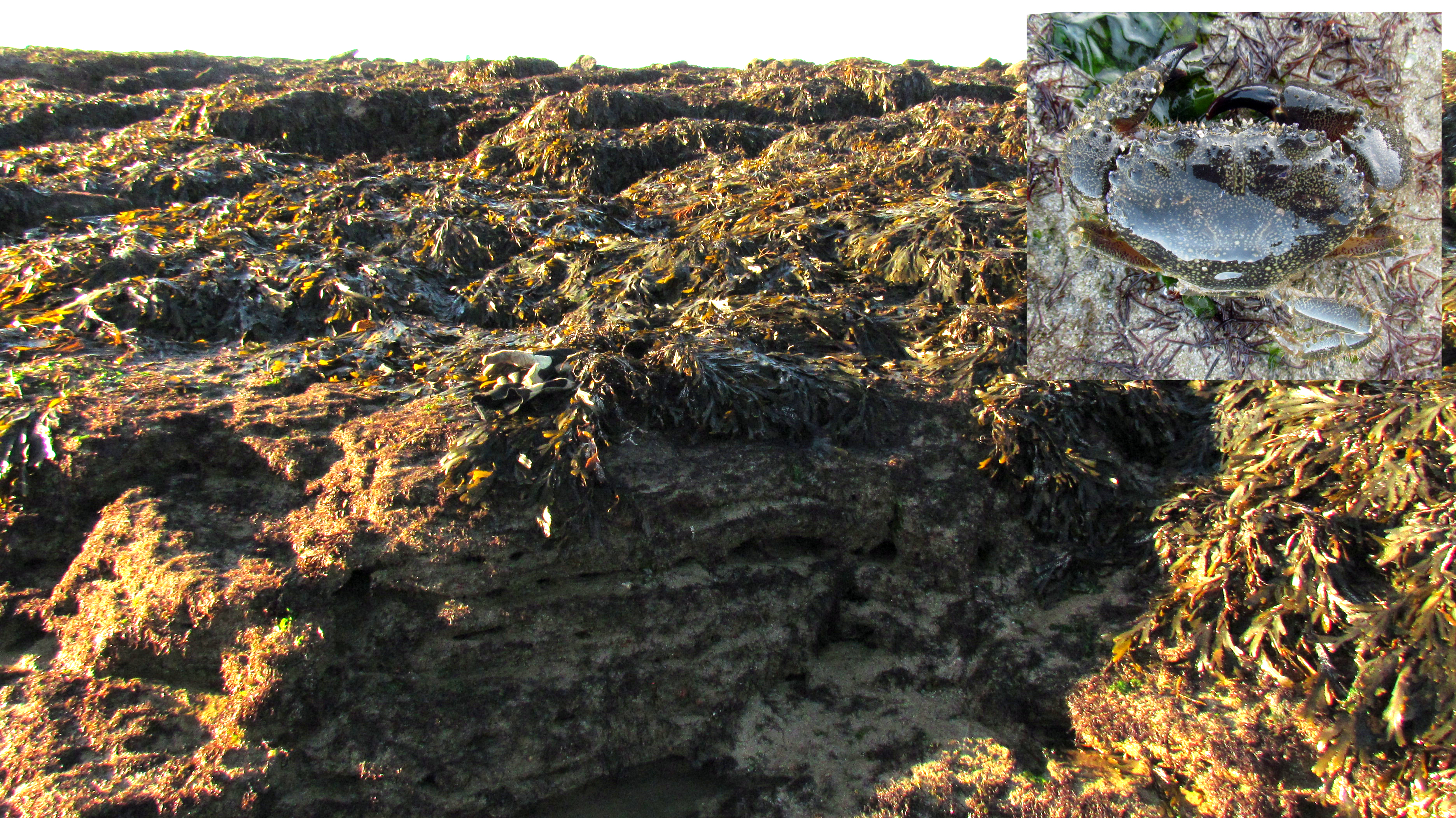
Picture: Rocky shore on the island of Hoedic with, in the foreground, one of the crab caves and one of its inhabitants, the warty crab.
© Catherine Dupont, CNRS
Indigenous oyster harvest and cultural connections from past to present
Leslie Reeder-Myers1
1 Department of Anthropology, Temple University, USA
Keywords: Historical ecology, oysters, Crassostrea, small-scale fisheries, Indigenous fisheries, archaeology
Historical ecology has revolutionized our understanding of fisheries and cultural landscapes, demonstrating the value of historical data for evaluating the past, present, and future of Earth’s ecosystems. Despite several important studies, Indigenous fisheries generally receive less attention from scholars and managers than the 17th–20th century capitalist commercial fisheries that decimated many keystone species, including oysters. I will briefly describe Indigenous oyster harvest through time at the broadest view in North and Central America. I will then focus on recent work in Honduras that more explicitly works to bridge past and present with local Indigenous and non-Indigenous shellfish harvesters in small-scale fisheries. Indigenous oyster fisheries were pervasive across space and through time, persisting for 5000–10,000 years or more. Oysters in some cases are woven into broader cultural, ritual, and social traditions. In others, they have been so thoroughly eliminated from the ecosystem that they are forgotten by local populations. Effective stewardship of oyster reefs and their ecosystems around the world benefit from centering Indigenous histories and including Indigenous community members to co-develop more inclusive, just, and successful strategies for restoration, harvest, and management.
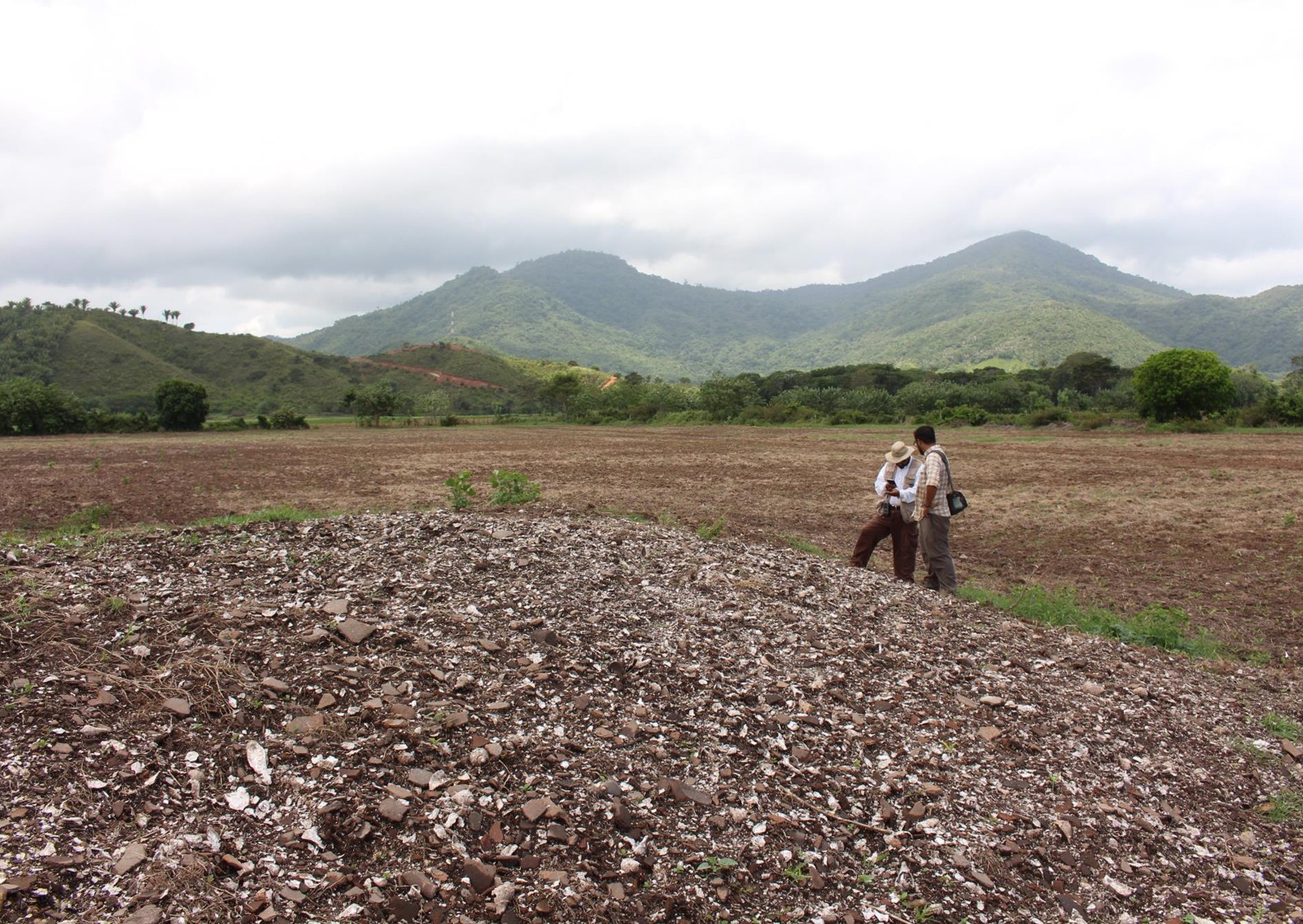
Picture: Archaeologist Alejandro Figueroa examines an archaeological shell mound at the Selin Farm adjacent to Guaimoreto Lagoon in Honduras.
© Leslie Reeder-Myers


