|
|
|
Sessions > Session 3
25 March 2026
15:45 - 17:00 - Auditorium de la Grande Galerie de l'Évolution
Aquaculture of marine invertebrates: opportunities and challenges
Session chair: Marco Hatch, Western Washington University (WWU), USA
Between animal and vegetal, the ambiguous status of oysters on French farms
Julie Dulat1,2
1PhD, UMR SENS associate, France.
2Postdoctorat Position, UMR LESSEM, INRAE, France.
Keywords: oyster farming, domestication, animal/vegetal, practices, anthropology
Oyster farming is the most known and most important aquaculture production field by weight in France. Oysters, filtrating bivalves, are mostly bred for their flesh along the French coast, including overseas ones. They are generally eaten raw and alive. I purposely use the verb "breed" because oysters are animals, although in everyday vocabulary the verb "cultivate" is used much more. We hear from oyster farmers "one cultivates oysters", "oysters are collected and not fished"... This way of describing, speaking of, and finally categorizing oysters questioned my fieldwork among farmers. While I was conducting ethnography in French farms, in three fieldworks (Corsica, Étang de Thau, and New Caledonia), the status of oysters and their role in the farms appeared ambiguous. What does the animal or vegetal status tell about the role and place of oysters in oyster farming? To what extent does this status have an influence on the practices then planned by farmers? While farmers are well informed that oysters are animals, the way they manipulate and qualify them depends on the agentivity they are assigned. This paper proposes to revisit the classification of oysters in literature and in the field. Analyzing how oysters are perceived provides insight into how they are treated. Here, I show how the status accorded to oysters reflects representations of oyster farming as a profession. In doing so, I propose some ideas about how oyster domestication works.
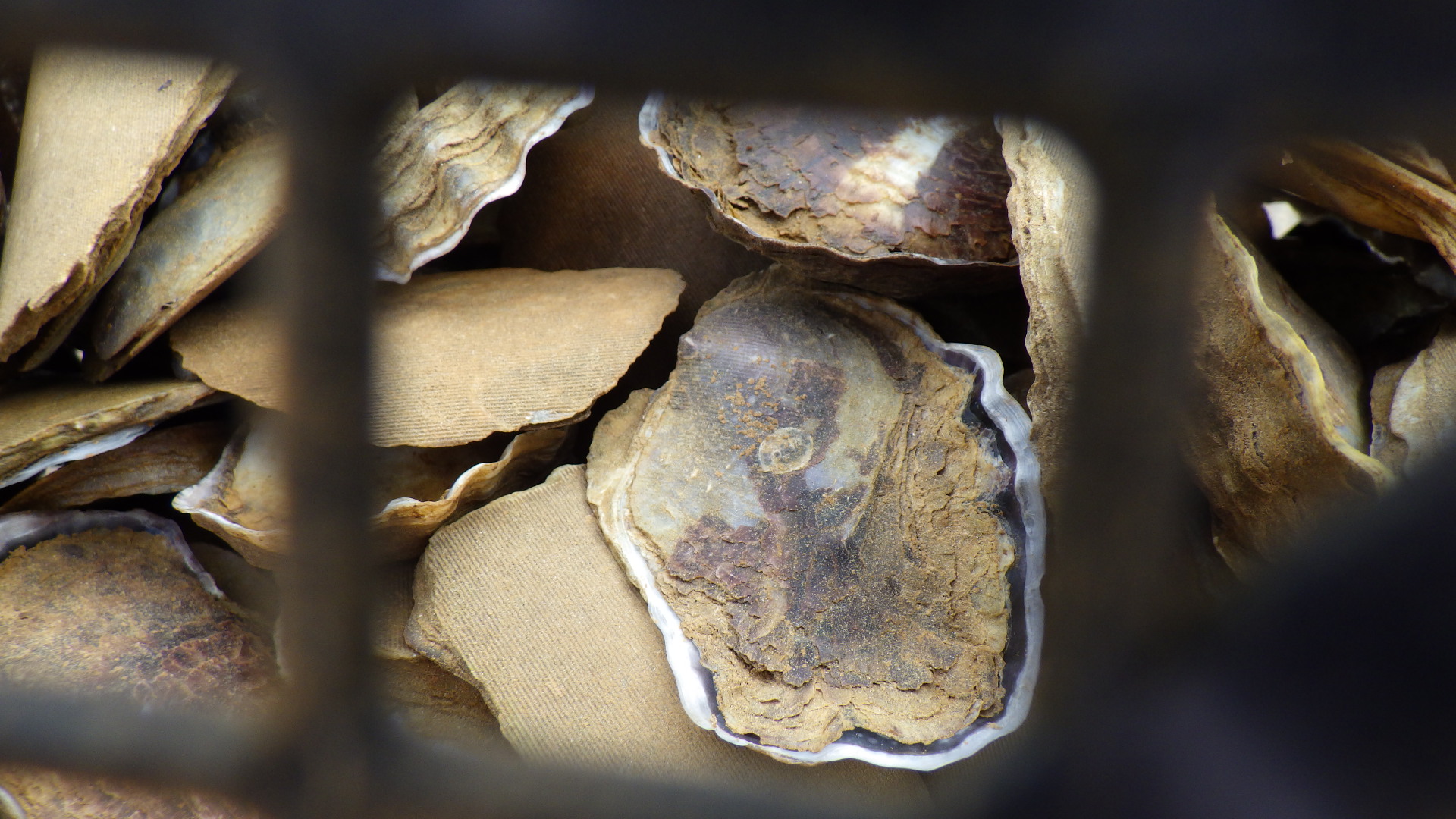
Picture: This picture represents a close up of Saccostrea spp. oysters in an Australian basket (2023, New Caledonia).
© Julie Dulat
From reciprocity to commodity: shifting human-invertebrate entanglements and socio-ecological change in the ecuadorian mangroves
Melva Treviño1
1University of Rhode Island (URI), South Africa.
Keywords: coastal livelihoods, ethnography, gender, mangrove forests, mangrove invertebrates, shrimp aquaculture
This talk examines how the introduction of commercial shrimp aquaculture has reshaped human relationships with marine invertebrates and coastal environments, using a case study from Esmeraldas Province, Ecuador. Shrimp farming emerged in that region in the 1980s as a development strategy that promised economic prosperity for surrounding communities. However, the introduction of this large-scale commercial activity resulted in the transformation of intertidal ecosystems once characterized by wild invertebrate harvesting into industrial shrimp ponds. Building on ethnographic research documenting multi-generational and reciprocal relationships between mangrove users and wild invertebrates, this talk shows how the introduction of farmed shrimp reconfigured care-based human-invertebrate relations into market-oriented and exclusionary forms of engagement. While national level statistics highlight the economic success of shrimp aquaculture, at the local scale, its expansion altered livelihoods, labor practices, and social norms in uneven and gendered ways. Drawing on in-depth interviews and participant observation, I show how shrimp aquaculture transformed previously deep connections between people, mangrove ecosystems, and intertidal invertebrates through capitalist production logics, disrupting traditional gathering practices, reshaping gendered access to coastal resources, and reframing meanings attached to both mangrove forests and the invertebrates inhabiting them. These transformations highlight how the introduction of a new invertebrate commodity – in this case, farmed shrimp – can act as a pivot point for ecological change and socio-cultural reorganization, with implications for coastal resilience and community well-being. This talk situates these findings within broader discussions of human-invertebrate entanglements and underscores the importance of attending to the social and ecological dimensions of aquaculture development.
.
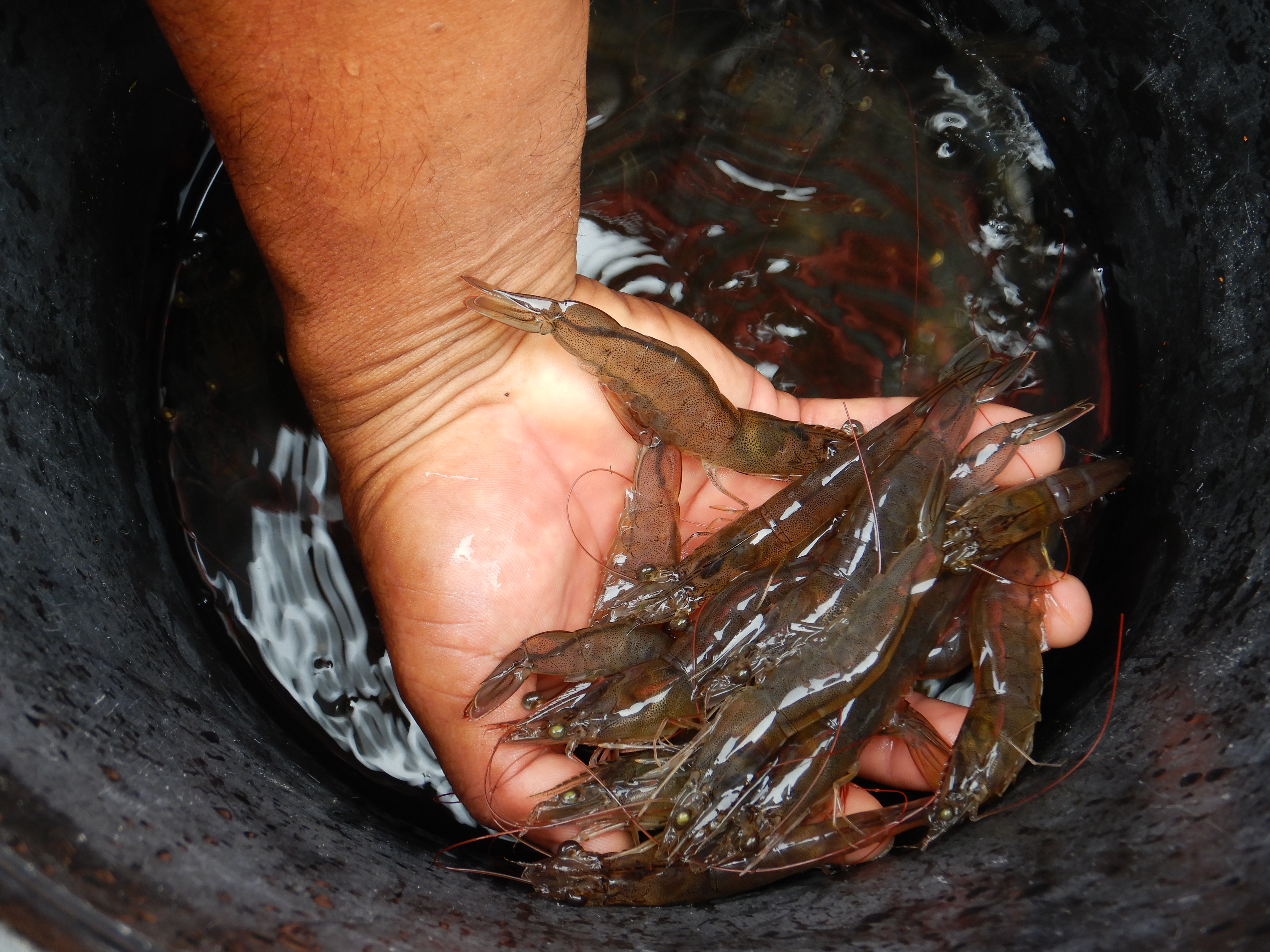
Picture: Whiteleg shrimp (Litopenaeus vannamei), an invertebrate species once harvested through low-intensity practices grounded in local knowledge, has become one of Ecuador’s primary export products.
© Melva Treviño
Feasibility of restorative aquaculture of Cittarium pica for reef recovery and food security in the Dutch Caribbean
Luc Roozendaal1, Alwin Hylkema2
1Van Hall Larenstein, University of Applied Sciences, Netherlands.
2Van Hall Larenstein, University of Applied Sciences; Wageningen University & Research, Netherlands.
Keywords: Cittarium pica; reef restoration; restorative aquaculture; social–ecological systems; local knowledge; Dutch Caribbean
Cittarium pica, known as whelk on St. Eustatius and Saba and Kiwa on Bonaire, is an important native grazer in the Dutch Caribbean and a cultural food resource for local communities. This study examines whether the species can be used in restorative aquaculture to support reef recovery, by controlling harmful algae growth, while rebuilding populations that can be sustainably harvested on the BES islands. Because C. pica naturally lives in exposed intertidal zones, we first tested how it performs at deeper reef depths. A depth-gradient experiment (2–20 m) showed that individuals maintain normal grazing behaviour across all tested depths. Follow-up releases on deeper reefs allowed us to evaluate retention, survival, and grazing impacts on benthic communities. To understand how ecological restoration intersects with local use and expectations, we analysed the whelk fishery using Ostrom’s social–ecological system framework and local knowledge. This revealed several constraints, declining local stocks, limited ecological baselines, logistical challenges, and distrust toward researchers and regulations, as well as clear opportunities, including strong cultural support for whelk enhancement, existing community harvesting norms, and high local demand. More broadly, this research shows that successful restorative aquaculture depends not only on biological feasibility but also on social alignment. While the flexibility of native invertebrates like C. pica opens new ecological possibilities, community knowledge and harvesting traditions strongly shape whether such interventions are trusted and adopted. Approaches that link reef restoration to local food security might strengthen community support, reduce tensions around management, and create shared incentives for long-term stewardship.
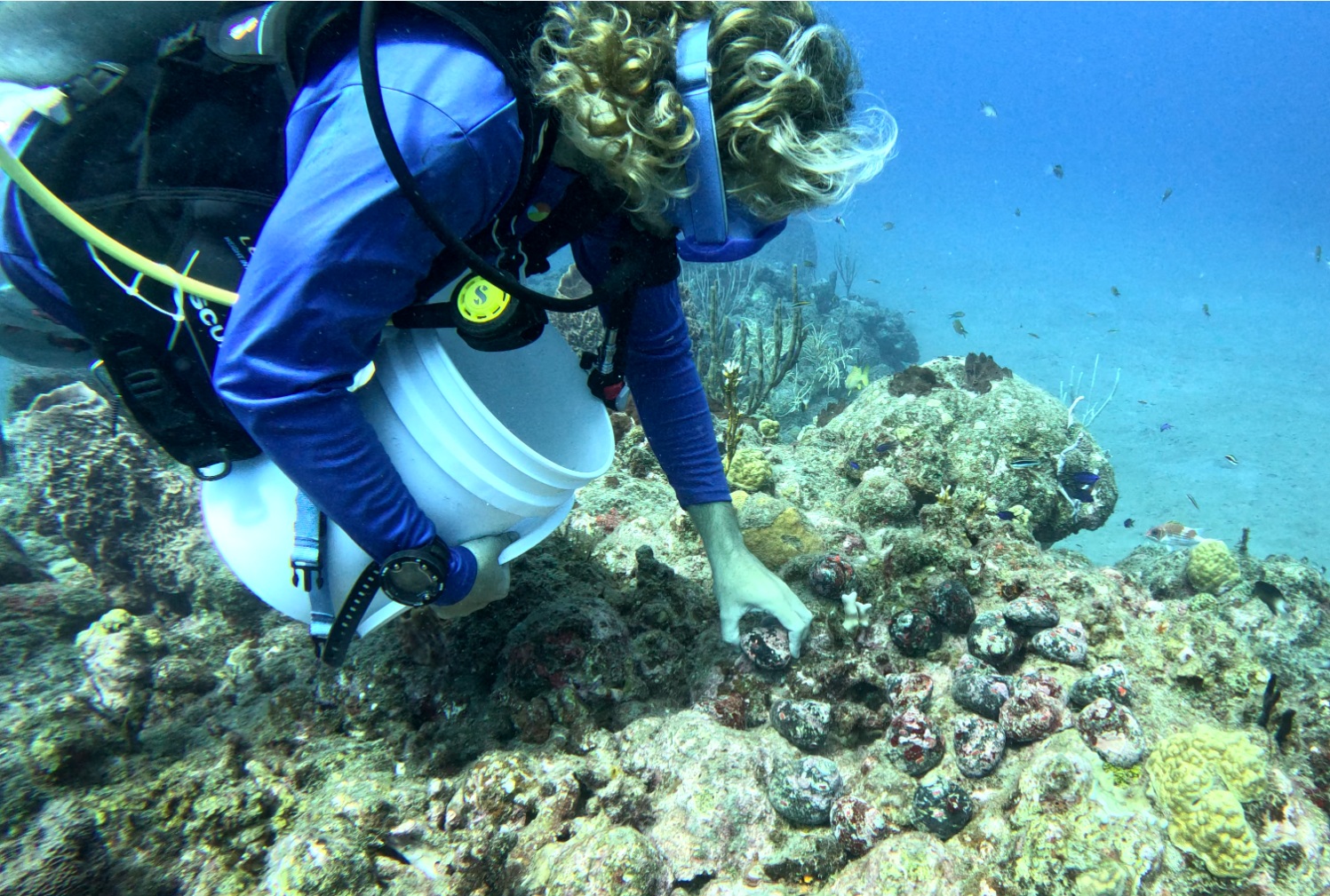
Picture: Researcher Luc Roozendaal placing Whelks on a patch reef around Saba, Dutch Caribbean to study their behavior, survival and movement overtime. The results of this study gave insights into how the Whelks can be used for reef restoration in the Dutch Caribbean by increasing grazing pressure and control excessive algae growth.
© Luc Roozendaal
Producing shrimp in certified farms: does it improve their welfare?
Urja Thakrar1, Alexander Antonarakis2, Charlotte Burn1, Andrew Crump1
1Animal Welfare Science & Ethics Group, Department of Pathobiology and Population Sciences, Royal Veterinary College, University of London, Hatfield, UK
2Department of Geography, School of Global Studies, University of Sussex, Falmer, UK
Keywords: shrimp aquaculture; invertebrate welfare; sustainable seafood production; sustainability certification; blue food systems
Around 440 billion shrimp are farmed and slaughtered each year. These animals receive little legal or industry protection, despite recent evidence suggesting a non-negligible likelihood of sentience in penaeid species. Consequently, farmed shrimp can experience poor welfare, including high stocking densities, stressful handling, high disease and mortality rates, and suboptimal water quality. Certification schemes have emerged as a potential method to improve practices, but their actual impact on shrimp welfare remains largely unexamined.
This research investigates whether a major sustainability-focused NGO’s certification scheme leads to measurable welfare improvements on shrimp farms. We conducted field assessments across 42 certified and non-certified Penaeus vannamei farms in India, one of the world’s largest shrimp exporters. We combined water-quality testing (pH, dissolved oxygen, temperature, salinity, turbidity, and nitrogen compounds) with farmer surveys covering stocking densities, mortality, disease outbreaks, feeding practices, and slaughter methods.
Our results indicate that certification had limited impact. For most welfare parameters, certified farms did not differ significantly from non-certified ones. I will discuss potential reasons for this, including challenges in standard implementation and monitoring, and suggest ways certification schemes could be strengthened to support both animal welfare and sustainable production.
As one of the few farm-level assessments of shrimp welfare, this study demonstrates how human management practices interact with ecological conditions to affect the lives of marine invertebrates. These findings provide insights into the functioning of aquaculture as a social–ecological system and inform debates on how certification can help to achieve more sustainable and ethically aligned farming practices.
.
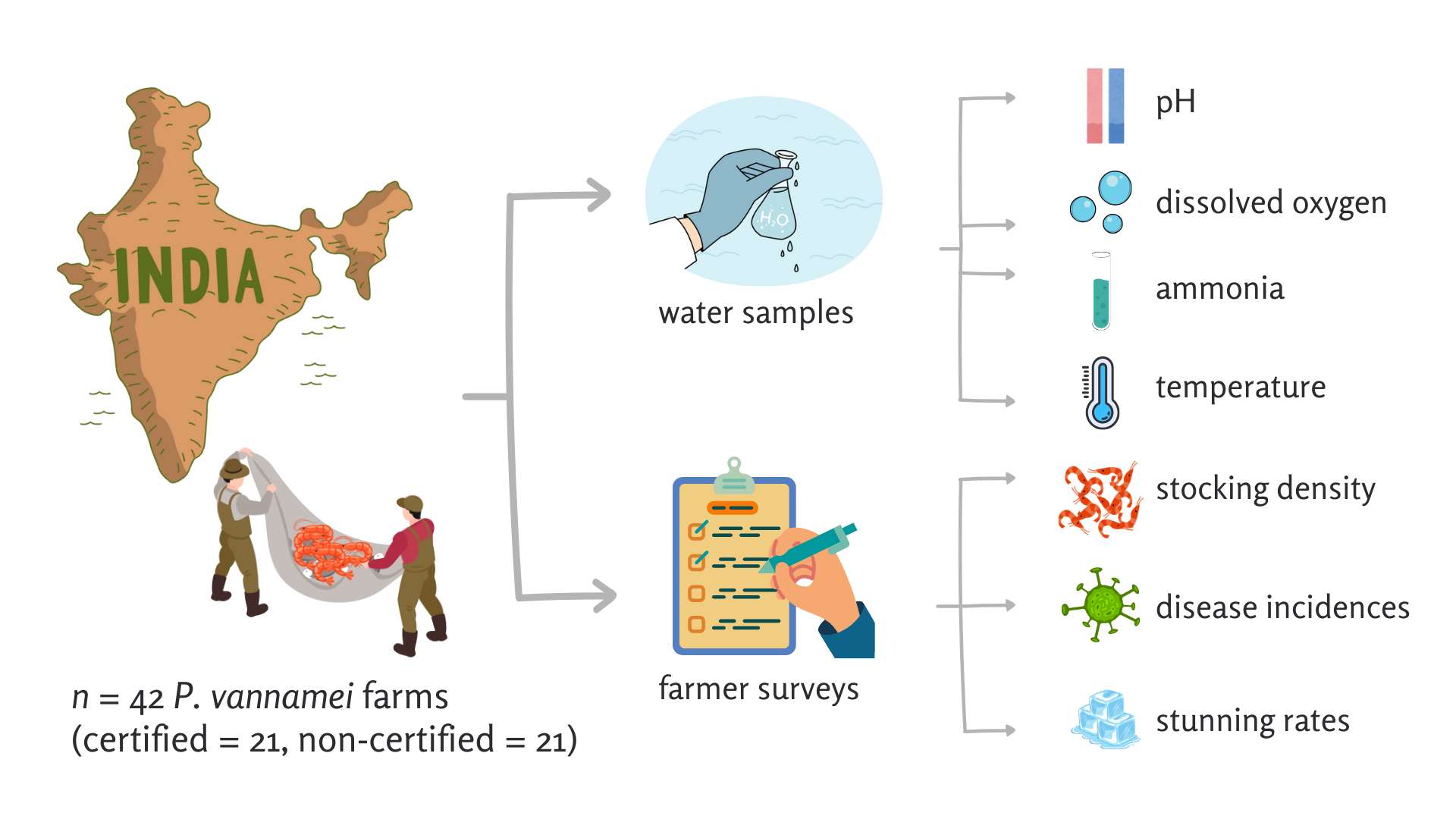
Picture: Diagram of the mixed-methods approach used in this study, integrating on-farm water quality testing with farmer surveys to compare welfare outcomes in certified and non-certified P. vannamei farms in India.
© Urja Thakrar


